Table of Contents
Starting a business is exciting, but getting people to notice your brand can be one of the biggest challenges. This is especially true for startups that are working with a small budget and a limited team.
This is where social media can make a real difference.
Platforms like Instagram, Facebook, LinkedIn, YouTube, and TikTok give startups a way to introduce their business, connect with potential customers, and share useful information without needing a huge marketing budget.
Creating social media profiles is only the first step toward building a strong online presence. A startup needs a clear idea of who it wants to reach, what it wants to say, and where it should say it.
So, what is the best social media marketing for startups?
There isn’t one strategy that works for every business. The right approach depends on the target audience, industry, budget, and goals of the startup.
In this guide, we’ll look at some simple and practical social media strategies that startups can use to build their online presence.
Why Social Media Marketing Is Important for Startups
For a new business, getting noticed is often the first challenge.
Before people can become your customers, they first need to discover your business. Social media can help startups introduce their brand to potential customers and stay connected with them over time.
A good social media strategy for startups can help with:
- Building brand awareness
- Reaching potential customers
- Sharing useful information
- Bringing visitors to a website
- Generating leads
- Building trust
- Creating relationships with customers
For example, imagine a new digital marketing agency that wants to attract small business owners.
Instead of posting only advertisements for its services, the agency could share simple SEO tips, social media ideas, website mistakes to avoid, and content marketing advice.
This type of content can give potential customers a reason to follow the business and learn more about its services.
The goal isn’t just to get followers. It’s to build an audience that is actually interested in what the business offers.
Best Social Media Marketing for Startups
There are many different ways a startup can use social media. The important thing is to start with a strategy that is realistic and easy to manage.
Here are some approaches that can work well for new businesses.
1. Choose the Right Social Media Platform
One common mistake startups make is trying to be active on every platform at the same time.
Keeping up with everything becomes harder when your business relies on a small team.
Instead, start by asking a simple question:
Where does my target audience spend their time online?
For example:
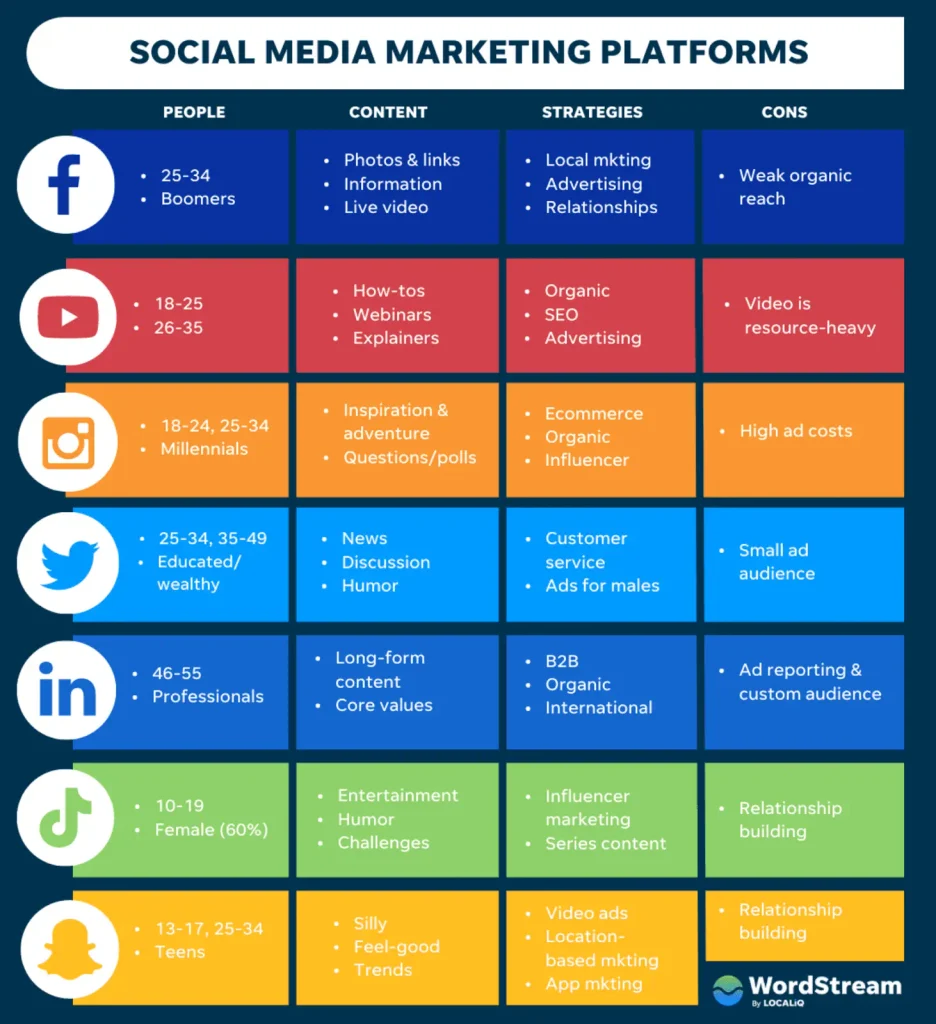
- Instagram can work well for visual businesses, creators, lifestyle brands, and local businesses.
- Facebook can be useful for local businesses, communities, and businesses targeting a broad audience.
- LinkedIn can be a good option for B2B startups and professional services.
- YouTube can work well for tutorials, educational content, and product demonstrations.
- TikTok can be useful for businesses whose target audience actively watches short-form videos.
A startup doesn’t need to use all of these platforms.
Starting with one or two relevant platforms can make it much easier to create good content and stay consistent.
2. Know Your Target Audience
Good social media marketing starts with understanding the people you want to reach.
Before creating content, think about your ideal customer.
Ask yourself:
- Who are they?
- What problems do they have?
- What are they interested in?
- What questions do they ask?
- Which social media platforms do they use?
- What type of content do they enjoy?
For example, a startup selling accounting software to small businesses could create content about managing invoices, tracking expenses, and organizing business finances.
The better you understand your audience, the easier it becomes to create content that feels relevant to them.
3. Create Content That Helps People
One of the simplest social media marketing ideas for startups is to stop thinking about every post as a sales opportunity.
Instead, think about how your content can help your audience.
A fitness startup, for example, could share:
- Beginner workout tips
- Simple exercise videos
- Healthy meal ideas
- Common fitness mistakes
- Customer stories
- Answers to frequently asked questions
This gives people a reason to follow the account even when they aren’t ready to buy something.
Over time, useful content can help a startup build familiarity and trust.
4. Try Short-Form Video
Short-form video has become an important part of social media content.
The good news for startups is that you don’t necessarily need expensive cameras or complicated equipment.
A smartphone can be enough to get started.
Some simple video ideas include:
- Quick tips
- Frequently asked questions
- Product demonstrations
- Behind-the-scenes clips
- Short tutorials
- Founder introductions
- Customer stories
The most important thing is to keep each video focused on one idea.
For example, instead of making a five-minute video about SEO, create a short video explaining one simple SEO mistake beginners should avoid.
5. Talk to Your Audience
Social media isn’t meant to be a one-way communication channel.
If someone comments on your post, respond to them. If a potential customer sends a question, answer it.
These small interactions can help a startup build relationships with its audience.
They can also provide useful ideas for future content.
For example, if several people ask the same question, that question could become a new Instagram post, Reel, LinkedIn post, or blog article.
By listening to your audience, you can discover what type of content they want to see next.
Which Social Media Platforms Should Startups Use?
There isn’t a single platform that is best for every startup.
The right choice depends on the type of business and the people it wants to reach.
Instagram can be a useful platform for businesses that can communicate visually.
Startups can experiment with:
- Reels
- Carousels
- Stories
- Product photos
- Educational posts
- Customer content
Facebook can be useful for local businesses, communities, groups, and businesses targeting a wider audience.
Startups can use it to share updates, educational content, videos, offers, and customer stories.
LinkedIn can be especially useful for B2B startups and professional services.
A startup could share industry tips, company updates, case studies, founder experiences, and educational content.
YouTube
YouTube is a useful option for businesses that can explain things through video.
For example, a software startup could create tutorials showing customers how to use its product.
TikTok
TikTok focuses heavily on short-form video and can be useful for businesses targeting audiences who actively use the platform.
Startups can experiment with educational videos, entertaining content, product demonstrations, and behind-the-scenes videos.
The important thing is to choose platforms based on your audience rather than simply following whatever platform is currently popular.
Social Media Marketing Ideas for Startups
Coming up with content ideas can be difficult when you’re just starting.
One way to make it easier is to create a few content categories and use them repeatedly.
Educational Posts
Teach your audience something useful.
For a digital marketing business, this could include:
- SEO tips
- Social media tips
- Content marketing ideas
- Website tips
- Common digital marketing mistakes
Behind-the-Scenes Content
People often like seeing what happens behind a business.
You could show your workspace, team, product development process, or even how you prepare content.
Customer Stories
If you have customers who are happy with your product or service, their experiences can become useful content.
Always get permission before sharing customer content.
Founder Content
Startups can also share the story behind the business.
For example, founders can talk about why they started the company, lessons they have learned, or challenges they have faced.
This can make the brand feel more personal.
Frequently Asked Questions
Your customers’ questions are a great source of content.
If customers regularly ask, “How does this work?” or “How much does this cost?”, those questions can become social media posts.
How to Build an Effective Social Media Strategy from Scratch
You don’t need a complicated plan to create an effective social media strategy.
Here is a simple process a startup can follow.
Step 1: Define Your Audience
Begin by clearly identifying the people you want your business to connect with.
Avoid trying to target everyone.
Step 2: Set a Goal
Set clear goals for what you want your social media presence to accomplish.
Your goal could be:
- Building awareness
- Getting website visitors
- Generating leads
- Increasing inquiries
- Growing an online community
Step 3: Choose Your Platforms
Focus on one or two social platforms where your ideal customers spend most of their time.
You can always expand later.
Step 4: Choose Your Content Topics
Decide what subjects you will regularly talk about.
For example, a digital marketing startup might focus on:
- SEO
- Social media marketing
- Content marketing
- Website tips
- Digital marketing basics
Step 5: Create a Content Calendar
A content calendar makes it easier to organize and schedule your social media posts ahead of time.
It doesn’t have to be complicated. You don’t need advanced tools; a basic spreadsheet can work just as well.
Step 6: Post and Engage
Publish your content consistently and make time to respond to comments and messages.
Step 7: Check Your Results
Look at your analytics regularly.
Find out which content gets the most engagement, clicks, inquiries, or other useful actions.
Then use those insights to improve your future content
Affordable Social Media Marketing for Startups
One of the biggest advantages of social media is that startups can begin without spending a huge amount of money.
Here are a few budget-friendly ideas:
- Create videos using a smartphone.
- Use free design tools.
- Plan and create several posts at once.
- Transform one blog article into a variety of social media content.
- Share customer questions as content.
- Focus on one or two platforms.
- Experiment with small paid advertising campaigns.
- Collaborate with relevant creators or micro-influencers.
Content repurposing is particularly useful when you’re working with limited time.
For example, one blog post about SEO could become:
- Three Instagram posts
- One short video
- One LinkedIn post
- Several Instagram Story ideas
- One infographic
Instead of constantly creating something completely new, you can find different ways to present the same useful information.
Social Media Marketing Errors Startups Should Avoid
Developing effective social media marketing skills doesn’t happen overnight. Making mistakes is normal, but some common problems can be avoided.
Trying to Be Everywhere
Managing multiple platforms can become overwhelming.
Start small and focus on the platforms that matter most to your audience.
Posting Only About Your Product
If every post says “Buy our product,” people may lose interest.
Try to balance promotional posts with educational, entertaining, and useful content.
Posting Inconsistently
A strong social media presence is about quality and consistency, not constant posting.
A realistic schedule that you can maintain is usually more useful than posting frequently for a week and then disappearing.
Buying Followers
A large follower count may look impressive, but followers who aren’t interested in your business are unlikely to become customers.
Focus on building a relevant audience.
Ignoring Comments and Messages
If people take the time to interact with your business, try to respond.
Social media works better when there is actual conversation.
Looking Only at Likes
Likes are only one part of social media performance.
Also look at:
- Website visits
- Shares
- Saves
- Messages
- Leads
- Inquiries
- Conversions
The most useful metrics depend on your business goals.
A Simple 7-Day Social Media Plan
If you’re not sure where to begin, here’s a simple example of a weekly content plan.
| Day | Content | Example |
| Monday | Educational | Share a useful industry tip |
| Tuesday | Short Video | Answer a common customer question |
| Wednesday | Behind the Scenes | Show how your business works |
| Thursday | Educational | Explain a common problem |
| Friday | Customer Content | Share a testimonial |
| Saturday | Engagement | Ask your audience a question |
| Sunday | Brand Story | Share a founder or business story |
Consider this schedule a helpful reference rather than a fixed routine.
The idea is simply to have a mix of content instead of posting the same type of content every day.
How to Measure Social Media Marketing Results
Once you start posting, it’s important to understand what is actually working.
Some useful metrics include:
Reach: How many people saw your content?
Engagement: Measure how actively people interact with your posts through likes, comments, shares, and saves.
Website clicks: How many people visited your website from social media?
Leads: How many potential customers contacted you?
Conversions: How many people took an important action, such as making a purchase or signing up?
Follower growth: Is your relevant audience growing?
It’s completely normal for some posts to get less attention than others.
Social media marketing involves testing different topics, formats, and messages. The goal is to learn from the results and gradually improve.
Frequently Asked Questions

How to Choose the Best Social Media Platform for Your Startup?
It depends on the startup’s audience and business model. A B2B company may focus on LinkedIn, while a visual consumer brand may find Instagram more useful. The best platform is usually the one where your potential customers are active.
How to Set a Social Media Marketing Budget for Your Startup?
There is no fixed amount that every startup should spend.Businesses can grow through organic content first, then invest in paid campaigns when they know what they want to achieve. The important thing is to monitor results before increasing spending.
How often should a startup post on social media?
There is no universal posting frequency. Start with a schedule that your team can realistically maintain. Consistency is more important than creating a schedule that becomes difficult to follow.
What type of content works for startups?
Educational posts, short videos, FAQs, customer stories, product demonstrations, behind-the-scenes content, and founder stories are some options. Testing different formats can help you discover what your audience prefers.
Can startups grow on social media without paid advertising?
Yes. Startups can use organic content, community engagement, partnerships, customer-generated content, and consistent posting. However, results can vary depending on the business, platform, audience, and quality of the content.
Conclusion
The best social media marketing for startups doesn’t have to be complicated.
Start by understanding your audience, choose the platforms that make sense for your business, and create content that genuinely helps people.
You don’t need thousands of followers or a huge advertising budget to start. What matters more is having a clear goal, staying consistent, talking to your audience, and learning from your results.
If you’re building a startup today, start small. Pick one or two platforms, create useful content, measure what happens, and improve your strategy as you learn.
That’s a much more practical approach to social media marketing than trying to do everything at once.
“Looking for support with your online growth? Explore Digital Marketing Services in Thrissur.”